

Many years ago, I was at a team offsite that felt more like a war room.
At first, we were talking about our company's goals and how our department could contribute. Then the tone changed. The conversation turned into how we could outperform a different department and get the limelight. If we wanted to get put on bigger projects and receive more resources, it would come at the expense of another department that we had to outshine.
The late great Catherine O'Hara sums up my response to this perfectly:

That moment stayed with me.
While that example was extreme, smaller versions of this dynamic show up in almost every organization:
You can see it between Sales and Marketing. Sales is focused on closing deals now. Marketing is focused on building long-term demand. Both goals matter, but they operate on different timelines.
Leadership and Frontline teams. Leaders set vision and targets. Frontline staff handle the daily realities of making those targets happen.
Legal and Marketing or Product. One side is responsible for reducing risk. The other is responsible for growth and innovation.
Long-time employees and new hires. Veterans trust systems that have worked in the past. New employees question those systems and look for improvements.
You also see it between generations. Some older employees believe younger colleagues are unwilling to pay their dues. Younger employees often feel misunderstood and judged by outdated ideas about work.
None of these groups are wrong. They simply carry different responsibilities and pressures. Problems arise when people stop recognizing how much they depend on one another. We have regain empathy for one another so that these roles can operate in alignment rather than in competition.
At Once Upon a Roll, we use strategic games to help teams practice that alignment.
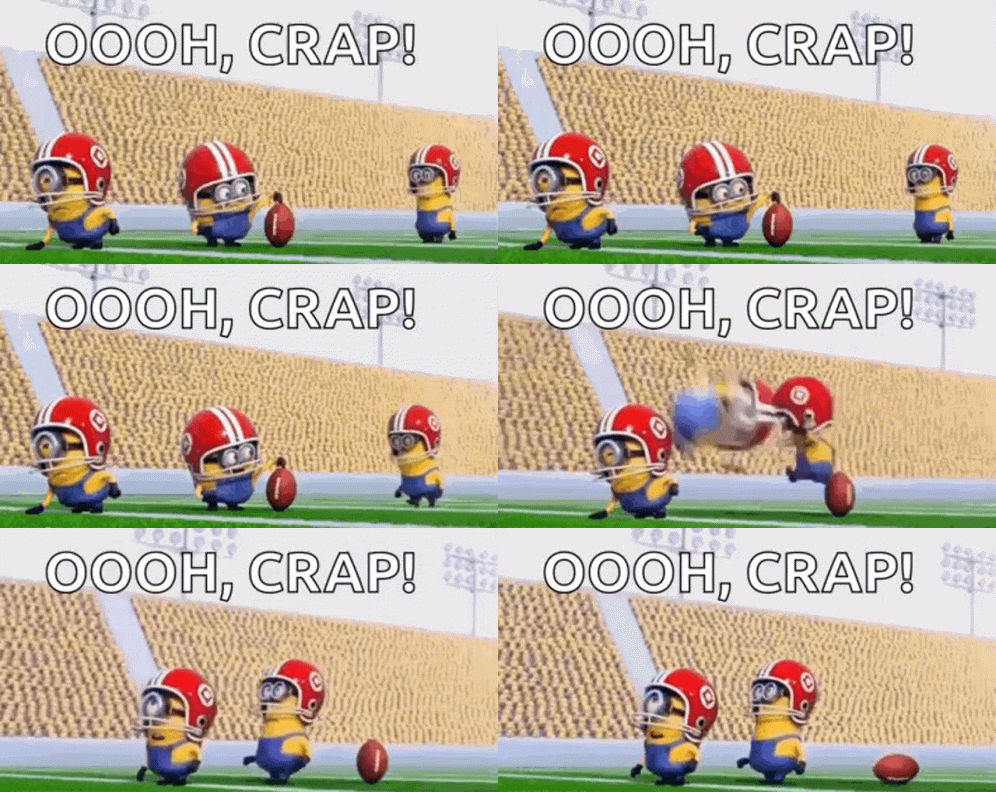
When a sports team prepares for a big game, they do not rely only on meetings about teamwork. They run drills. They practice plays. They build coordination through repetition so that when the stakes are high, they know how to work together and don't end up like this on game day:
Strategic gaming provides a similar kind of practice for workplace skills.
One game we often use is called Sky Team. In this game, two players take on the role of pilot and co-pilot trying to land an airplane. Each person has access to different information required to land the plane. They must coordinate actions with limited visibility into what the other person is doing, because during the game, they cannot speak.
Success depends on trust, timing, and communication in advance of the game. If one person makes decisions without thinking of the co-pilot, the plane veers off course. If both hesitate and wait too long, the opportunity passes. If they fail to time things correctly, the landing fails.
The structure mirrors real workplace dynamics, where teams operate with partial information and shared responsibility.
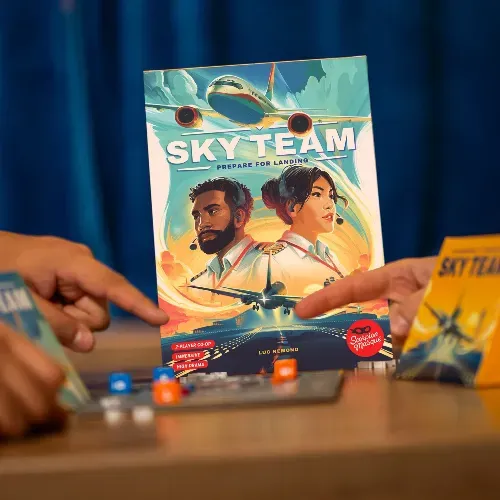
After the game, we debrief the experience. We look at where confusion appeared, when trust made a difference, and what helped the team coordinate more effectively.
The discussion also reveals natural communication styles. Some people try to figure everything out on their own. Some rush to act because they feel urgency. Others prefer to wait until they have more information before deciding. Some speak often and think out loud. Others stay quiet and assume alignment without confirming it.
Most people are not fully aware of these tendencies in real time. The game makes those patterns visible in a safe and neutral setting. Because it is a shared challenge rather than a real work conflict, people can reflect without feeling defensive.
When teams understand their own habits and see how their colleagues approach problems differently, it becomes easier to adjust. They begin to recognize that different styles are not obstacles but strengths that need coordination.
Strategic play creates a practical way for teams to experience interdependence. Instead of talking about collaboration as an abstract value, they feel what it takes to succeed together.


