

On January 1st, while many were sleeping off New Year's Eve, I was headed to the airport to fly to Atlanta for the inaugural event of Dungeon Master University.
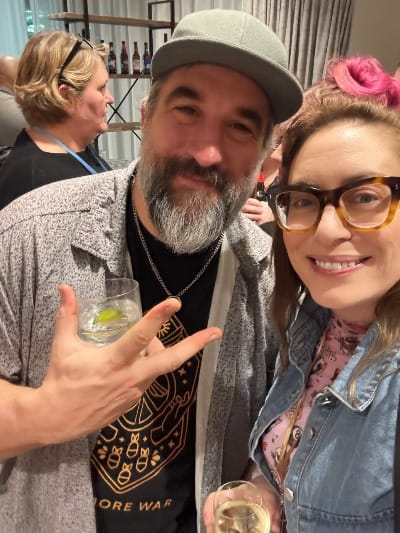
As a Dungeon Master (sometimes called a Storyteller or Game Master), I was really excited to meet 100 fellow DMs and spend two and a half days honing my skills.
Being a DM is weirdly isolating. You're literally the only person at your table who can't talk about what's coming next in the story. You know all the secrets, hold all the plot threads, and have to keep a straight face when your players make decisions that completely derail three weeks of preparation.
So getting in a room with other people who understand the particular brand of madness that is "I spent four hours crafting an elaborate mystery and instead they decided to befriend a squirrel and open up an animal sanctuary" is a gift!
People were there from all walks of life:
- Business owners who specialize in offering D&D for companies (like me!)
- Professors who taught D&D to university students to help them build real world skills around negotiation and conflict management.
- High school teachers who ran D&D at their local schools.
- GMs who run paid games online.
- Hobbyists who want to improve their game and storytelling skills.
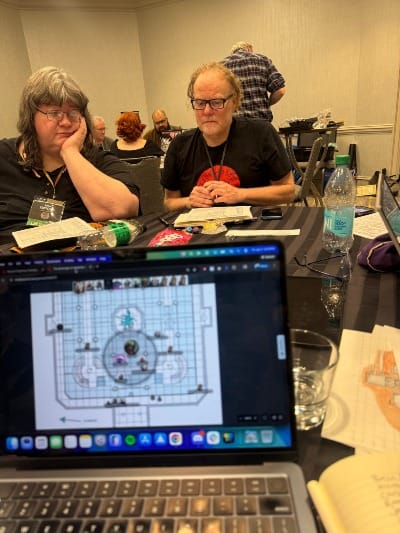
Whatever brought them there, we all shared one thing: a desire to swap stories and help each other get better. To figure out how to keep things exciting and commiserate over the brilliant story hook you spent weeks crafting that your group completely ignored in favor of, I don't know, opening a bakery.
DMs create the world, but players get to decide what matters to them and how they engage with it.
Sometimes they latch onto something you didn't think was important. Sometimes they ignore the giant flashing neon sign you put directly in front of their faces.
If that's not a metaphor for real life, I don't know what is. Life presents you with options, but you decide what matters. Sometimes the 'side quest' becomes your main story.
Being a DM has taught me a lot of things:
- How to hold ideas lightly and not get too attached to any one thing, since it might not work out.
- How to take feedback and adjust without losing the thread entirely.
- How to expect the unexpected and then still be surprised anyway.
- How to facilitate a group so everyone feels heard, even when they're all shouting different solutions at the same time.
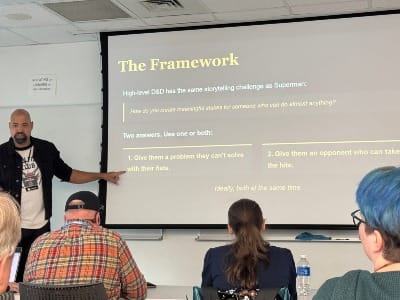
One of the talks that really landed for me was about "high-level DMing" by B. Dave Walters.
In D&D, characters level up from 1 to 20 as they gain experience.
Very few games ever reach Level 20, where characters are essentially demigods who can literally wish things into existence, bring people back from the dead, and stop time itself. So how do you challenge the players?
I don't have designs on running a high-level game, but that doesn't matter, because B. Dave's entire philosophy is an excellent parallel for life.
He puts it this way: high-level characters can do just about anything in a game, but they can't do everything. And that's when triage becomes the real challenge. What do you let burn?
We face this challenge every day as humans. There are a million options for what we could do. But what will you sacrifice or say no to, in order to say yes to something else? And how do you know you made the right choice?
More options doesn't mean more freedom. It means more consequential choices.
You can have incredible skills, resources, connections, opportunities. But you've still only got 24 hours in a day and one body to move through the world.
The question stops being about what you're capable of and becomes: what deserves your attention right now? What are you willing to say no to?
Constraints breed creativity.
B. Dave designs his high-level adventures around impossible choices. Not "can you beat the monster" but "you can save the city OR stop the villain, but not both – choose."
And that's what I think about when people dismiss games as "just play."
This is the work.
- Learning to make difficult choices when you can't be certain of the outcome.
- Learning that every option has a cost.
- Learning that power doesn't make decisions easier, it makes them more consequential.
- Learning that the scariest thing isn't whether you'll survive. It's who you'll become along the way.
That's the "level" we're all playing at day to day, really. We just don't always realize it.
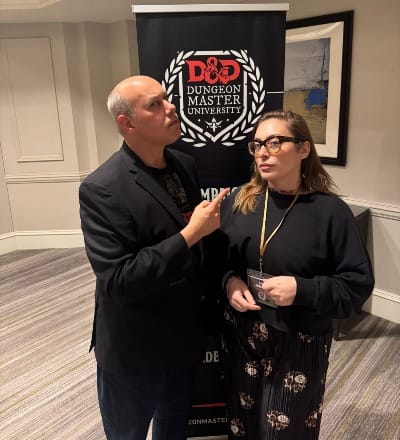
I left DMU with pages of notes, a bunch of new friends who get it, and honestly, a renewed sense of why I do this work. The games we run, whether for teams or individuals, are about way more than having fun.
They're about creating spaces where people can practice being braver, more creative, more decisive than they usually are. Where the stakes feel real enough to matter, but safe enough to fail.
If you want to experience how D&D can help you better navigate these questions, join me for a taste test! No experience or materials necessary. We'll play a single session of Granny D&D that helps you get a hang for the game, and experience the magic that has everyone talking. And yes, you'll be playing a granny -- how great is that?
Register for my next Taste Test game on January 30th 👇